From ideas for regenerating derelict industrial sites and mitigating the impacts of climate change, to innovative ways of improving the quality of life in cities, the worldwide annual student design competition Urban SOS explores some of the biggest challenges we face today.
“The competition seeks to instill truly cross-disciplinary thinking in the emerging generation of built environment professionals,” says Bill Hanway, global head of architecture at AECOM. The company is celebrating seven years of sponsoring and organizing the competition which has attracted submissions from thousands of students in dozens of countries.

“Right from the very first competition, we were impressed by the fresh ideas and approaches that the students brought together,” Hanway added. “From every corner of the world, they always show tremendous freedom and innovation in thinking around and through the challenges. Of course, we are talking about their lives, so it’s always fantastic to learn about how they want to shape their futures.”
The 2016 competition took the theme of Fair Share, exploring how the principles of the sharing economy could be applied to support more equitable access to resources, improve the built environment and enrich the quality of life of urban residents. The competition was presented by AECOM with the nonprofit architecture organization the Van Alen Institute in partnership with 100 Resilient Cities — Pioneered by the Rockefeller Foundation.
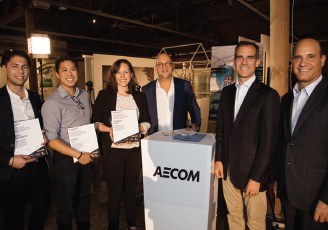
Left to right: Daniel Lau, Joseph Rosenberg and Lindsay Rule of the University of Pennsylvania, Bill Hanway, global head of architecture at AECOM, LA Mayor Eric Garcetti, AECOM Chairman and CEO Mike Burke
Stronger together
“As a generation that’s immersed in the sharing economy and is particularly sensitive to its implications for equity, today’s students are well positioned to identify possibilities that practitioners might not even imagine,” said David van der Leer, Executive Director of the Van Alen Institute. “I’m excited to see how students translate the intangible ideas of the sharing economy that Urban SOS addresses into improving the physical dimension of cities.”
Multidisciplinary working is crucial to success. “The challenges we face as a society aren’t simple ones, and the solutions won’t come from a single discipline,” continued van der Leer. “Collaborating with people from different fields can result in projects that understand this reality, that are more interesting, and that are more attuned to the needs and desires of diverse populations.”
The power of collaboration is highlighted by Stephen Engblom, Global Director of AECOM Cities. “Collaboration between disciplines and jurisdictions is our most powerful tool in addressing and solving the world’s most complex challenges. Our competition challenges students to collaborate in ways beyond traditional discipline-oriented training, requiring them to team with students from other departments or parts of the world to address new opportunities. Once they have a taste for this from the competition, it is our hope that students will continue to collaborate in their professional careers. The interdisciplinary platform is also why our alliance with Van Alen and 100 Resilient Cities is a natural fit.”
“The collaboration and discussions between students and jury members are exciting, the ideas are fascinating, and it’s a wonderful opportunity for people with so many different views and types of expertise to get together,” says Bryna Lipper, Senior Vice President for City and Practice Management at 100 Resilient Cities. “Of course, the students are at the heart of the competition and their visions of the future are key to how we shape our cities and help them to become more resilient to the physical, social and economic challenges that are a growing part of the 21st century.”
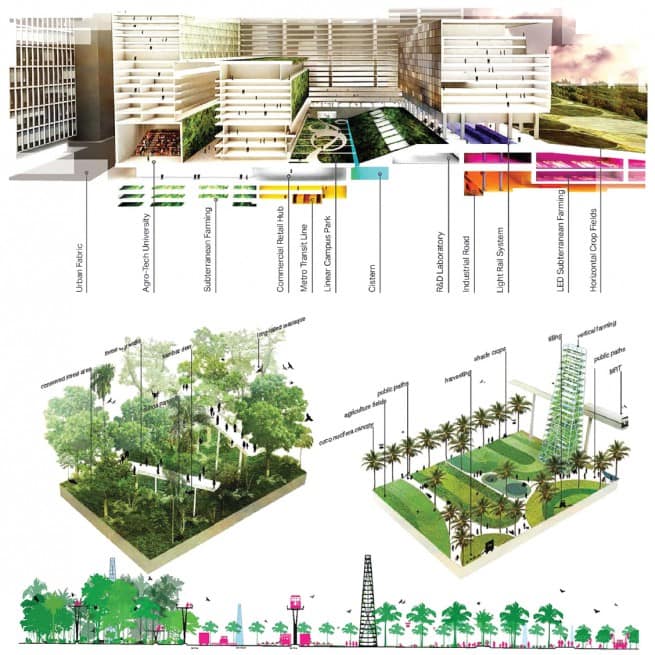
All Systems Go 2015 winners
Using productive landscapes as the catalyst for future development, industry and infrastructure in Singapore were at the heart of the innovative winning submission by the University of Pennsylvania students for the 2015 contest.
Responding to the theme All Systems Go, the student team comprised Daniel Lau, Joseph Rosenberg and Lindsay Rule, winning US$15,000 in prize money and up to US$25,000 in-kind staff time to support the implementation of the winning proposal.
“Working together was inspiring because we were all driven by an interest in seeing how landscape design can respond to the issues and needs of cities now and in the future,” said Joseph Rosenberg, a landscape designer. “Landscape can play a significant role, not just in how cities look, but, importantly, also in how they work.” Since winning the competition, Rosenberg is now working with AECOM in Los Angeles.
Working together was inspiring because we were all driven by an interest in seeing how landscape design can respond to the issues and needs of cities now and in the future.
Joseph Rosenberg, landscape designer