


Scotland’s energy future: planning priorities ahead of the 2026 election
With the 2026 Scottish Parliament election on the horizon, now is the time to ask whether our planning system is ready to deliver the scale of energy infrastructure required to achieve net zero. In this article, planning experts Zoe McClelland and Siobhan Wolverson explore how greater reliability in planning and decision-making can drive delivery, strengthen community trust and unlock wider social and economic benefits.
If you’re involved in delivering renewable energy or grid projects in Scotland, you’ll know the industry is moving at pace — not just in terms of the speed of project delivery, but also the evolving regulatory and policy landscape.
We’ve seen the formation of the National Energy System Operator for Great Britain (NESO), the publication of Clean Power 2030 (CP2030), and the introduction of strategic energy planning through the SSEP (Strategic Spatial Energy Plan) and RESPs (Regional Energy Strategic Plans), where ‘regional’ for us means Scotland-wide.
This sits alongside the Centralised Strategic Network Plan (CSNP) for transmission and the publication of the RIIO T3 Business Plans for Scottish Power Energy Networks (SPEN) and Scottish and Southern Electricity Networks (SSEN), which set out investment in Scotland’s transmission infrastructure for 2026–2031.
And that’s not even the full picture:
- There is grid connection reform — where having planning consent is more important than ever, as you can’t secure a connection without it.
- The Onshore Wind Sector Deal, introduced almost two years ago, has made notable progress — including the development of a standardised set of Section 36 consent conditions and guidelines aimed at streamlining Environmental Impact Assessments (EIAs) for onshore wind projects.
- There is the Planning and Infrastructure Bill, which is making its way through UK Parliament and includes several changes to the Electricity Act 1989 relating to pre-application processes and public inquiry requirements in Scotland.
- The UK-wide guidance on Community Funds, launched in March 2025, provides financial benefits to communities hosting new or upgraded energy transmission infrastructure.
- And finally, the Good Practice Principles for Community Benefits from Net Zero Energy Developments, where the Scottish Government’s consultation reviews the economic and social benefits from net zero energy developments to help both communities and developers.
The sheer volume of change could be overwhelming, yet amidst this complexity, we still need to look ahead. What does the future of energy infrastructure look like? And with a Scottish Parliament election on the horizon in 2026, what should the planning system be asking of our future government?
Ambition to action
There’s no doubt that governments, agencies and policymakers in Scotland and across the rest of the UK are working hard to deliver the infrastructure required to meet our net zero goals — but the challenge is unprecedented. While energy demand remains relatively stable until 2030, it’s projected to nearly double by 2050 due in part to increased investment in electric vehicle transition and the phasing out of gas boilers.
For planners, this is a familiar story — we need to do things faster, more efficiently and better. But with a recognised shortage of planners and recruitment challenges across the sector, we need to think strategically about what we ask of our current and future political leaders.
We believe the answer lies in reliability — and that reliability depends on consistency. Here are five key areas where greater consistency in planning and decision-making can make a tangible difference in Scotland:
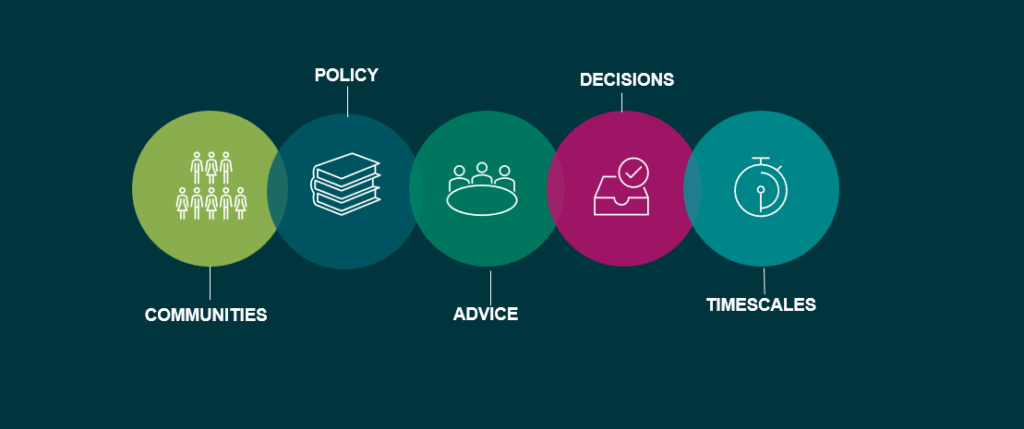
- Consistency for communities is paramount, and strategic planning should be proactive, not reactive. The RESPs aim to be a bottom-up exercise, which should provide an indication of where energy infrastructure will be located up to and beyond 2030. Communities need early visibility of projects, easy access to community funds, and the tools to engage meaningfully. If equipped with the right knowledge at the right time, local communities are more likely to accept these projects on their doorsteps. It’s the job of our politicians — both nationally and locally — to communicate not just the climate case for net zero, but also the wider benefits for energy security and tackling fuel poverty.
- Consistency of policy can drive these ambitions forward. The National Planning Framework 4 (NPF4) has brought welcome clarity for renewable and transmission projects. The next iteration must reinforce this certainty, not dilute it. A stable policy environment is essential for long-term investment and delivery.
- The requirement of key agencies therefore is to provide confident, consistent, and timely advice. Often advice is risk-averse and has been slow to adjust to the changed policy context of NPF4. Proactive and collaborative approaches to pre-application engagement and resolving issues during determination should be the norm.
- This should support greater consistency in planning decisions. There is no doubt that NPF4 was a step change, but often issues are being played out at a project level. Where tensions arise — for example, around heritage settings or landscape impacts — clearer interpretation of NPF4 policy, perhaps through Chief Planner letters, could give decision makers the confidence to resolve statutory objections. A national review of decision-making trends could help identify inconsistencies and promote best practice across planning authorities and statutory consultees.
- Finally, and fundamentally, consistent timescales will unlock huge value for Scotland. The Energy Consents Unit’s (ECU) commitment to progressing Section 37 applications within 12 months is commendable. The Onshore Wind Sector Deal sets similar targets: 12 months for standard applications, or 24 months with Public Local Inquiry (PLI). However, nearly two years on, these targets are not being met — with Section 36 applications taking an average of 29 months without a PLI, and 38 months with one. While the ECU has almost doubled its resources in the past year, it remains to be seen whether this will improve performance or simply maintain the current pace. To deliver CP2030 and bring about the wider benefits that it will entail, planning needs to stick to our end of the bargain and get closer to meeting these timescales.
Political priorities
Despite progress, uncertainty persists across the energy sector. Grid connection reform remains a major bottleneck. Supply chain fragility threatens delivery timelines. Skills gaps in planning and engineering are growing. And investment uncertainty continues, exacerbated by regulatory flux and political cycles. So, what should government prioritise? To support the energy transition, we believe there are several steps the Scottish Parliament must take:
- Investment in planning capacity, including funding training, recruitment and retention with more great programmes like the Scottish Government Future Planners initiative.
- Championing planning as a net zero enabler — and position it as a proactive driver of Scotland’s net zero ambitions.
- Support digital tools and knowledge hubs — including the expansion of digital platforms, data and information sharing, and resources like the National Planning Improvement Hub to improve transparency, streamline applications and accelerate decision making.
- Ensure cross-border policy alignment — working collaboratively with the UK Government, especially with England’s Planning and Infrastructure Bill, to harmonise planning and energy policy to unlock investment and enable delivery at scale.
- Embed community benefit frameworks — so that transmission infrastructure is welcomed, not resisted, and communities are supported to participate meaningfully in the transition.
The coming years will be defining for Scotland’s energy infrastructure. The sector is brimming with ambition, but delivery hinges on a planning system that is consistent, confident and well-resourced. With the right political support, planning can be the driving force behind a smooth and successful transition to net zero — with all the economic benefits that can bring.
This article is based on an original version first published in the RTPI’s Scottish Planner in November 2025. Click here to read it.