Career Path Spotlight: Jennifer Williams
At AECOM, employees are encouraged and supported to pursue career paths that best fit their unique capabilities, interests and aspirations. Our Career Path Spotlight series takes you through the rewarding career journeys of our employees who have stepped out of their comfort zone and taken on new challenges to chart their own successful careers and growth.
This time, we caught up with Jennifer Williams, Vice President, Civil Engineering, Water, in the U.S. West region to discover how she chose the path she’s on today.
Hi Jennifer. What do you do for AECOM?
I’ve been with AECOM and legacy companies for almost 30 years. I contribute to both business development and project delivery by representing AECOM on a variety of professional societies, managing client relationships and programs, and serving technical roles on dam inspection, analysis, risk assessments, design and construction projects. After raising two daughters, I enjoy spending time in the outdoors of Colorado.
Tell us about your career journey.
I didn’t know what an engineer was until I was about 16. Back then, we didn’t have STEM classes like students do now. My older sister went to the Colorado School of Mines, an all-engineering school, and that was the first time I really learned what engineering was all about. I was inspired by what she was doing and decided to follow in her footsteps.
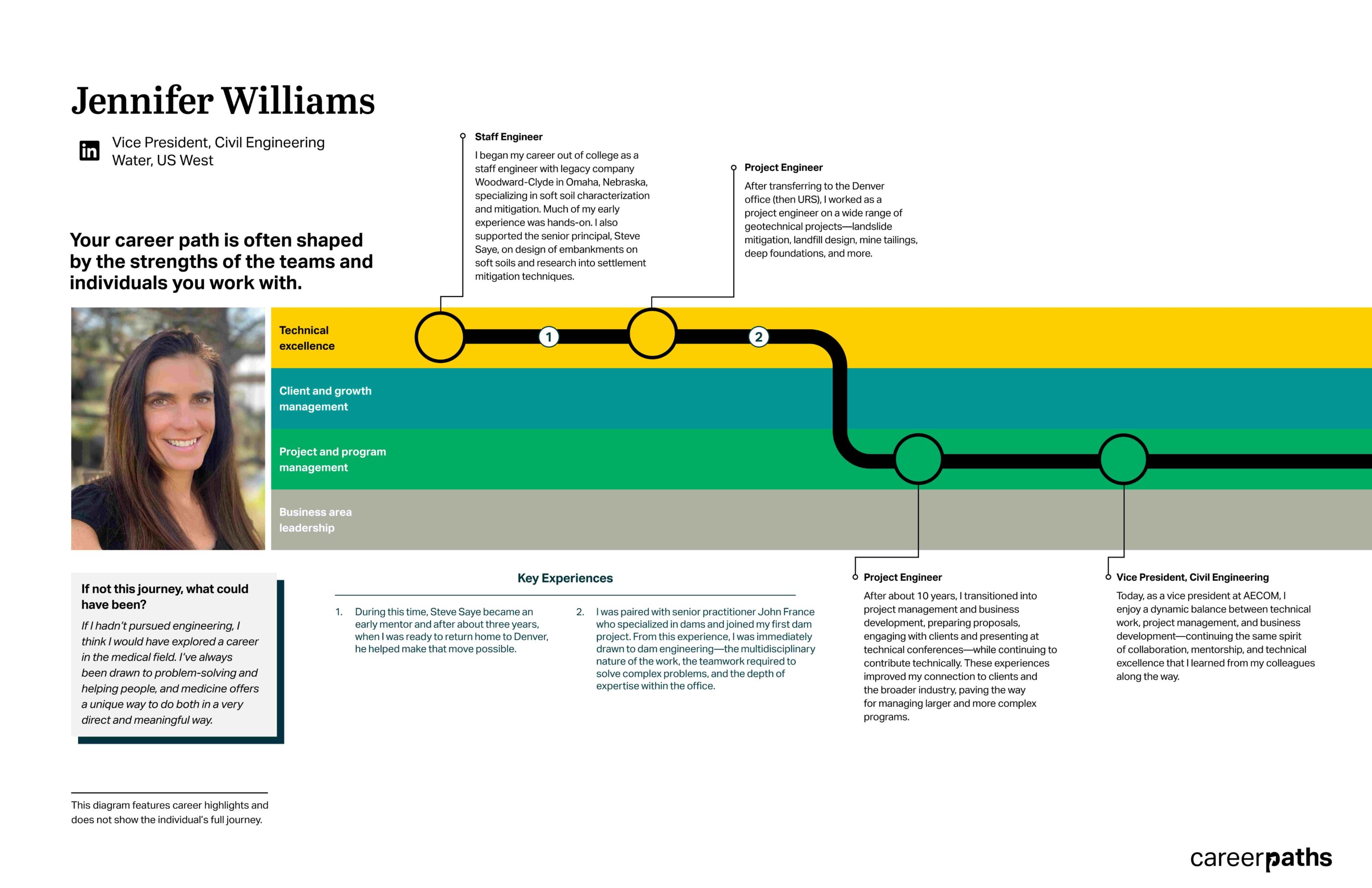
I began my career out of college as a staff engineer with legacy company Woodward-Clyde in Omaha, Nebraska, specializing in soft soil characterization and mitigation. Much of my early experience was hands-on — working behind a cone penetration test (CPT) or drill rig logging soils or performing construction oversight on civil earthwork projects. I also supported the senior principal, Steve Saye, on design of embankments on soft soils and research into settlement mitigation techniques. He became an early mentor, and after about three years, when I was ready to return home to Denver, he helped make that move possible.
After transferring to the Denver office (then URS), I worked as a project engineer on a broad range of geotechnical projects, including landslide mitigation, landfill design, mine tailings dams, and deep foundations. I eventually asked to be paired with John France, a senior practitioner specializing in dams, and soon joined my first dam project. From that experience, I was immediately drawn to dam engineering — the multidisciplinary nature of the work, the teamwork required to solve complex problems, and the depth of expertise within the office. I was motivated by the variety and technical challenge of each project, the range of geotechnical analyses involved, and the opportunity to collaborate closely with multiple disciplines.
After about 10 years, I transitioned into project management and business development, preparing proposals, engaging with clients and presenting at technical conferences — while continuing to contribute technically. These experiences improved my connection to clients and the broader industry, paving the way for managing larger and more complex programs.
Today, as a vice president at AECOM, I enjoy a dynamic balance between technical work, project management and business development. I currently serve as the technical lead and project manager for the design of a new 300-foot-tall embankment dam here in Colorado. Additionally, I’m the program manager for technical engineering services for a large hydroelectric company in the Northwest, contributing to a broad range of dam-related work. Beyond that, I assist state dam safety programs in advancing their use of risk-informed decision making, including Colorado, Hawaii and New Mexico.
I’m also actively engaged with the broader dam safety community through various roles — serving on the Board of Directors for the U.S. Society on Dams, chairing the Technical Advisory Committee for the Association of Dam Safety Officials, and being the U.S. representative on the Embankment Dam Committee for the International Commission on Large Dams.
How has mentorship helped you on your path?
Your career path is often shaped, if not defined, by the strengths of the teams and individuals you work with. I’ve had the great fortune to work with a few very impactful mentors — John France, Dick Davidson, and Steve Saye to name a few — who played crucial roles in my career. Their openness in sharing knowledge and their passion for excellence really inspired me and helped me grow. What stood out most was their direct candor; they gave me honest feedback that accelerated my learning curve. They also trusted me by giving responsibility while always having my back — checking my work and redirecting me when needed. That balance of support and challenge really helped propel my career forward and taught me the value of strong mentorship.
What’s something you wish someone told you years ago?
Something I wish I’d learned earlier in my career is the value of seeking out diverse perspectives and learning from peers and senior practitioners alike. Never hesitate to ask questions or seek advice — no matter your level of experience. Collaboration and curiosity lead to better solutions, and there’s no shame in not having all the answers; in fact, some of the best ideas come from simply asking for input.
What advice do you have for women who want to get into dams or another traditionally male-dominated industry?
My advice to women interested in entering the dam industry, or any traditionally male-dominated field, is to not define yourself by the gender balance around you. Seek out mentors, both male and female, who support your growth and push you to take on challenges. Be confident in your skills, stay curious and keep learning. Earn respect through a strong work ethic, technical excellence, and an open, collaborative attitude. The industry needs diverse voices and approaches, especially in engineering fields where collaboration, innovation and problem solving are essential.
If not this path, what would have been your career plan B?
If I hadn’t pursued engineering, I think I would have explored a career in the medical field. I’ve always been drawn to problem solving and helping people, and medicine offers a unique way to do both in a very direct and meaningful way. Whether it was becoming a nurse, a physical therapist, or working in medical research, the idea of contributing to people’s health and wellbeing really appealed to me.