


Infrastructure reimagined: Turning assets into outcomes in New York City

George Guillaume is the NYC Metro+ Executive, where he works to foster our deeply rooted relationships with clients and stakeholders to ensure we work as partners in progress for New York City. He is also heavily involved with volunteering and mentoring in the community, serving on the boards for the Greater Jamaica Development Corporation and the ACE Mentor Program of Greater NY. With 20 years in the infrastructure and aviation industry, George’s track record of guiding teams, building trust and shaping environments where people and communities thrive demonstrates his leadership and impact across the NY/NJ region.
New York City is entering a new phase of transformation, where infrastructure must be viewed as a public service — defined not just by what we build but by how well it performs for the people who live here.
In New York City, we’ve historically defined infrastructure by what we design and build — airports, tracks, bridges, tunnels and buildings. It’s measured in capital plans and delivered as projects.
That way of thinking focuses on physical assets, not on how those investments impact the people who rely on them every day. What would happen if we shifted the focus and asked a different question — what if infrastructure is defined by and valued for the outcomes it creates?
We view infrastructure as outcomes because in a city as complex as New York, the real value of infrastructure is what it enables. Whether people can get to work reliably, afford to stay in their communities and trust systems to hold up under pressure.
That’s the perception shift we believe in, and it’s shaping how, together, we are moving this city forward.
From systems to everyday life
In New York City, we don’t experience infrastructure in silos. Transportation, housing, energy, water and public space don’t operate independently — and neither do the outcomes they create.
A transit system isn’t successful because it moves trains. It’s successful if it connects people to opportunities consistently. Housing isn’t measured solely by the number of units delivered. It’s also defined by whether it creates stability and access for the people who live there.
These systems are interdependent. Housing without access to transportation doesn’t work. Transportation without resilient energy systems isn’t sustainable. Public space without integration into communities doesn’t deliver value.
We see this every day in how projects come together across the city. As prime consultant for the preliminary engineering and final tunnel design of the Second Avenue Subway, we helped shape the system’s integration into surrounding neighborhoods. This project isn’t just expanding the transit network. Instead, it’s reshaping access across Manhattan’s East Side, with the goal of reducing strain on existing lines while supporting new patterns of growth, connectivity and opportunity.
Focusing on these interconnected outcomes is what systems-oriented thinking looks like in practice.
Execution is the real challenge
There is a tendency to frame infrastructure challenges in terms of funding. But in New York City, the bigger constraint is execution.
All our projects are built within active systems comprised of aging infrastructure, dense neighborhoods, competing priorities and limited space. Every deliverable must work within the existing ecosystem, and every decision has tradeoffs.
Planning for resilience alone is insufficient because systems must perform under real conditions. Designing for access is important but sustaining that access over time is the real challenge. These lofty goals require coordination across agencies, disciplines and stakeholders in ways that have historically been fragmented.
This is evident in many projects we’ve championed across New York City. Our work as program and construction managers on the Grand Central Madison expansion reflects the level of collaboration required to deliver infrastructure within an active, constrained urban system where design, construction, operations and passenger accessibility must align in real time.
That execution is where infrastructure produces real outcomes, and it’s where leadership matters most.
A different definition of infrastructure
If we want to view infrastructure as outcomes, then that changes how we define investment.
The emphasis switches from funding individual assets to creating synergy between systems that work together to improve everyday life. That means measuring success not by what gets built, but by what gets better.
It also requires a partner who understands how these systems connect and how to deliver within the constraints of a city like New York. That’s the role we’re focused on. Not just providing expertise, but helping align strategy, design and execution to achieve lasting, equitable outcomes.
Because in this city, infrastructure is tangible and personal. It shows up in daily routines, commutes, neighborhoods and whether the city works for all the people who depend on it.
Our work as joint-venture program managers on the Borough-Based Jails Program for the New York City Department of Design and Construction reflects this shift by delivering new facilities that bring people in custody closer to courts, healthcare, legal support and their communities. This program underscores how infrastructure and policy aligned around dignity, care and opportunity can create stronger outcomes and support a safer, more connected city.
New York City is entering a new phase of transformation, where infrastructure — from transportation to public facilities — must be viewed as a public service, defined not just by what we build but by how well it performs for the people who live here.
As New Yorkers designing and building for New Yorkers, we are invested in that performance because we live with the outcomes too.
Infrastructure is not the track beneath the train. It’s the opportunity at the destination.
And in New York City, that’s the only definition that matters.
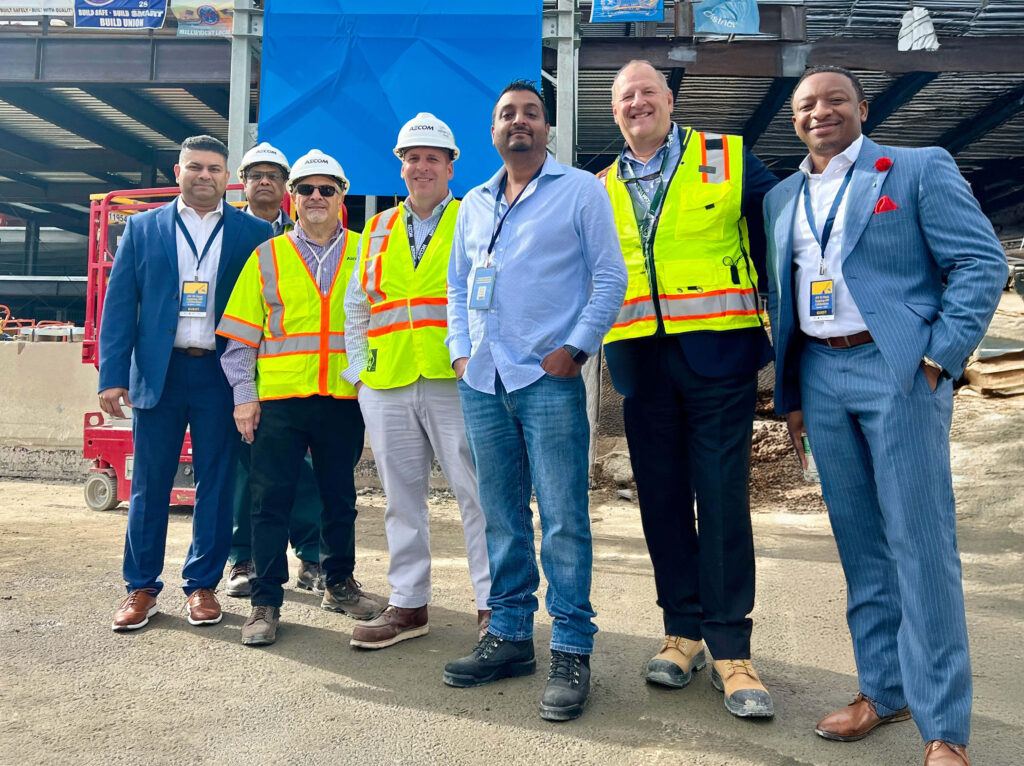
(George, on the far right, and the AECOM team on site at JFK Terminal 6)
Other articles by this author