


People Spotlight: Meet Eva Kleinert
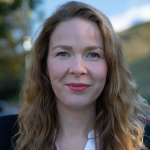
Our People Spotlight series gives you an inside look at our technical experts around the world. This week, we are highlighting the Associate Director for Equality and Social Impacts from our Environment and Energy business lines in Edinburgh, United Kingdom and providing you insight into their inspiration and work.
Eva Kleinert is Associate Director for social impact research at AECOM with a strong focus on research and evaluation, and commitment to sustainability. Eva leads our Social and Equality Impact team in the UK, and is the technical lead for the monitoring and evaluation of social impacts, design and delivery of primary research, and integration into social research reports and assessments for our Energy and Environment business lines. In addition to her experience at AECOM, she has five years of experience as a team lead and analyst for the Scottish Government, including as lead analyst for international, Europe and Brexit and senior research manager for the rural economy. She has designed and managed numerous research projects.
Eva has four years of research experience in gender labor market inequalities, family policies and policy evaluation, applying both quantitative and qualitative methods. She holds a doctorate in comparative social policy from the University of Kent.
Tell us about what inspired you to join the industry.
I’ve always had a strong interest in people’s lives, communities and local economies — how they are affected by policy changes or local developments. My career started as a freelance journalist in Germany, reporting on local issues. That involved many conducted interviews and group discussions, trying to understand how people were impacted on the ground with my recorder and notepad. That experience sparked my curiosity about evidence-based impact assessments.
After completing my master’s degree in the York, UK, I pursued a doctorate in Labour Market Studies at the University of Kent. As an academic, I wanted to look more methodologically into evidence-based impact assessment at a cross-national scale. My research focused on labour market inequalities, particularly how women are less represented in managerial positions. This academic foundation led me to work for the Scottish Government, where I led on research to understand and evaluate Scotland’s rural economy and analysed the impacts of national and European policies on communities. I really enjoyed applying my academic knowledge at a national and regional level and gaining experience as a government social researcher.
Joining AECOM felt like the perfect next step. I wanted to investigate infrastructure projects — like energy developments and new road networks — shape the lives of people and local communities. I was particularly motivated to contribute to the transition to net zero by assessing social impacts thoroughly. Today, our work involves extensive primary research with community members and a wide range of stakeholders, using structured methodologies. It’s a long way from relying solely on a notepad and a recorder. This approach allows us to produce evidence-based reports, and it’s given me the opportunity to combine my methodological expertise with my passion for community engagement.
I wanted to investigate infrastructure projects — like energy developments and new road networks — shape the lives of people and local communities. I was particularly motivated to contribute to the transition to net zero by assessing social impacts thoroughly.
What is your favorite AECOM project that you’ve worked on and why?
I tend to have two types of favourite projects. First, I love projects with a strong emphasis on primary research. As much as I enjoy desk-based research, I find that the most valuable insights we get are from speaking directly to those affected by new energy infrastructure, road schemes or policy changes.
This can include speaking to businesses, community members and public sector organisations. We conduct a lot of interviews and focus groups, and I find those projects the most interesting because they allow us to test what we learn from literature and evidence reviews against real experiences on the ground. Right now, for example, we are conducting a large research on public attitudes towards energy infrastructure across Great Britain. We’re running a high number of focus groups and backing our findings with representative surveys, ensuring a robust evidence base.
The second type of project I love is the kind that lets me dive deep into spreadsheets, logic models and impact assessments. I try to pin down exactly what is driving a particular impact, determining how best to measure it, and then designing a monitoring framework from the ground up. This involves identifying indicators, creating data collection tools, and analysing the data to measure impacts. It’s a different kind of work, but I find it equally rewarding.
I love projects with a strong emphasis on primary research. As much as I enjoy desk-based research, I find that the most valuable insights we get are from speaking directly to those affected by new energy infrastructure, road schemes or policy changes.
Tell us a story of how your work positively impacted the community.
Improving social outcomes is at the heart of everything we do. Whether we’re assessing how policies affect groups with protected characteristics — such as women or ethnic minorities — through equality impact assessments, or examining how new energy infrastructure will shape the lives of coastal communities in Scotland, our work always centres on people and place. These examples illustrate how community impact is the foundation of every project I’m involved in.
We go beyond simply documenting activities, funding or job creation. Instead, we focus on the long‑term effects — asking what meaningful, lasting difference an initiative has made or is likely to make. Using systematic research and evidence‑based methods, we uncover how communities truly experience change.
For instance, in recent research for a client, we engaged directly with coastal communities to understand how new offshore wind developments could affect them. We captured both positive and negative impacts and presented clear, balanced findings in the final report.
When our research highlights that particular groups may be disproportionately affected, we provide targeted, actionable recommendations to address those impacts. A recent project examining proposed changes to bus routes is a good example. We explored how shifts in schedules could affect people from different socio‑economic backgrounds or demographic groups. For example, older adults or others more dependent on public transportation might face greater challenges. By identifying these nuances, we can help clients design fairer, more inclusive solutions.
We go beyond simply documenting activities, funding or job creation. Instead, we focus on the long‑term effects — asking what meaningful, lasting difference an initiative has made or is likely to make. Using systematic research and evidence‑based methods, we uncover how communities truly experience change.
Share a piece of career advice
My main advice is twofold. Firstly, have confidence in your abilities. Whether you’re tackling a challenging project or navigating a complex situation, trust in your skills and determination to succeed.
Secondly, ask for help when needed. At AECOM, teamwork is a cornerstone of our success. There’s always someone who can help you get a project over the line or provide guidance on specific aspects. Don’t hesitate to reach out — it’s not a sign of weakness but a way to strengthen your work.